Wildcat welcomers
Asian American Peer Mentors are the stars of the orientation week galaxy.
by Gianna Liu

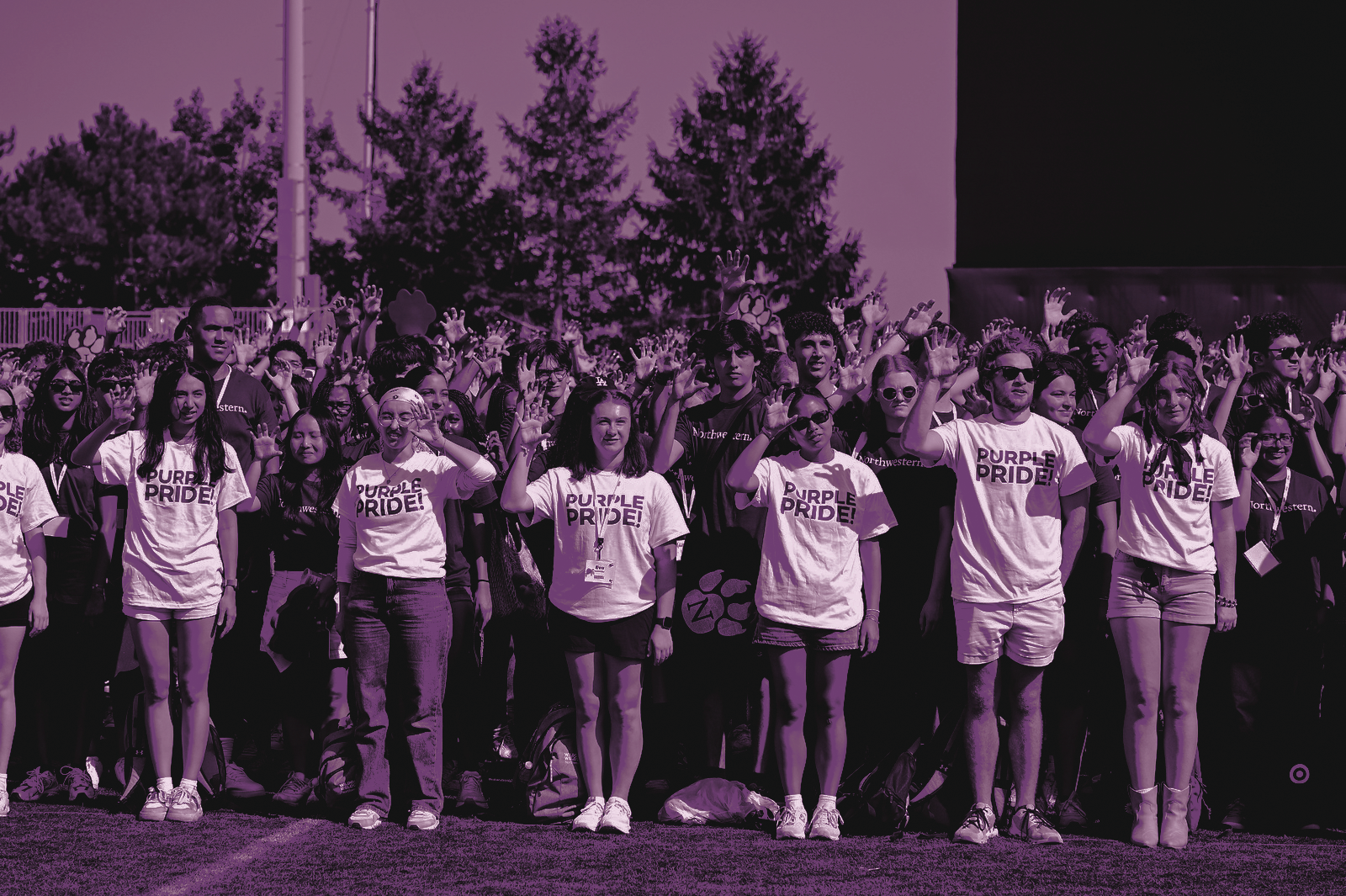
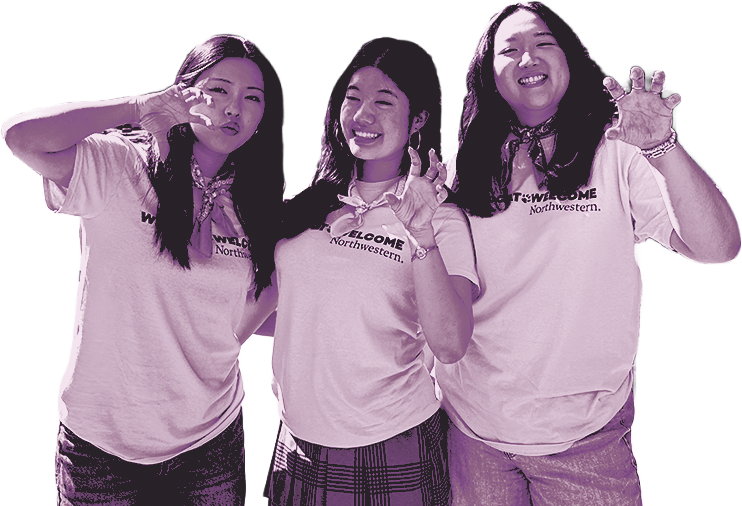
Dressed in bright shirts, bandanas, sunglasses, gray “Student Transition” backpacks and enthusiastic smiles, PAs are hard to miss on campus. They are the backbone of Wildcat Welcome, guiding new students through six to eight full days of campus tours and orientation activities.
In her welcome week as a first-year, McCormick third-year Trayi Sharma never went to Purple Pride or saw the PA dance. As a PA, Sharma was able to relive Wildcat Welcome.
The PA job description calls for five or six meetings in the spring and five full training days leading up to the weeklong welcome event. With all the mandatory training sessions, being a PA might feel like adding another class. Even so, Sharma applied to do it.
“I struggled when I came to school; I think my PA was really amazing and did a really good job with helping us. I kind of wanted to pay that forward a little bit,” Sharma says. “If she could do that for me, maybe I can do that for someone else.”
In addition to leading their students during Wildcat Welcome, McCormick PAs also hold Personal Development meetings, which are regular check-ins with their students for the first and second quarter. When meeting with her students, Sharma strives to be honest with her own experiences academically transitioning to college.
Beyond her role with new students, Sharma made new connections in the strong and inviting PA community. “Being a PA was where I met the most people outside of my major and my classes that I'm like, ‘Oh my gosh, we're going to be really good friends,’” Sharma says.
For Communication third-year Jenna Jeon, being a PA reminded her of the importance of mentorship — not just in school, but in her culture.
To Jeon, applying to college as a first-generation Korean American was daunting. However, her older sister guided her throughout the entire college process. Jeon hoped to be a PA in order to be a similar helping hand for others.
In Korean culture, age is heavily valued in society and social interactions. Sunbaes are those with more experience in school or in a workplace, whereas hoobaes are their juniors and should address their sunbaes with utmost formality. Jeon tries to channel this “wisdom mindset” towards her PA work.
“I wanted to be a resource for them that [first-years] can always reach out to. Even if I don't know the answer, I can guide them to somebody who does,” Jeon says. “That mentorship aspect is something I really dived into.”
In college, sunbaes take the initiative to share academic resources or guide the hoobaes through their entire academic or career paths. Outside of McCormick PAs holding Personal Development meetings, formal PA responsibilities end after Wildcat Welcome. However, Jeon makes an effort to stay connected with
her students.
“My first year as a PA, I kept in touch quarterly — just checked in if anyone wanted help registering for classes. I was always available,” Jeon says. “This year, I still plan to keep in touch just because as a PA, you were their first point of contact, and you led them through a lot.”
Among other responsibilities, PAs guide new students through conversations about well-being, safety and inclusion. After two years as a PA, this year was Weinberg fourth-year Nik Sung’s last time going through welcome week. As the Director of Weinberg for the 2025 Wildcat Welcome Board of Directors, Sung trained PAs to facilitate True Northwestern Dialogues (TNDs), which cover sensitive topics that he says many international students may not be exposed to.
“Coming from my experience living in Korea in elementary school, there are barely any conversations about diversity and structural racism, as well as ... sexual health, sexual assault prevention and violence,” Sung says.
To comply with President Donald Trump’s executive orders targeting DEI content at universities, Northwestern rebranded the Diversity, Equity and Inclusion office to Office of Community Enrichment. In addition, parts of the PA training were adjusted to fit the new DEI protocol. Sung believes that training PAs to confidently engage students in these tough conversations is crucial.
While training PAs through TNDs, Sung emphasizes the important role PAs take on shaping a new student’s experience at NU. Sung comes from a predominantly white town, and has since interacted with many people from different backgrounds, cultures, religions or high school experiences. Sung says it is an honor to be the first person that constructs new students’ way of thinking.
“Wearing a PA shirt does give you a lot of power and privilege,” Sung says. “I want to use that privilege of being a returning Northwestern student to best welcome the new student communities and also show that Northwestern is a really exciting place.”
Following this new administration shift, Communication third-year Ash Aranha appreciates continuing discussions on race, culture and identity with his PA students.
He recalls meeting an East Asian student during an admitted students day who worried that, just like in high school, he wouldn’t get casted for lead roles at NU because of his race.
“He asked me there, ‘Do Asians get cast in things?’” Aranha says. “I remember being like ‘Yes, yes they do.’”
Aranha has also found ways to proudly share his Asian culture with his students. He tells them about the Indian restaurants in town that he likes — the ones he goes to when he’s missing his dad’s cooking. And when a student wanted to learn how to make Indian food for his girlfriend, Aranha offered to teach them.
From leading March Through the Arch, debriefing with his PA group, giving school and life advice and witnessing his students make their first friends, Aranha had many memorable moments as a first year PA. His experience helped him feel deep appreciation for the NU community.
“There’s something about it that just warms your soul,” Aranha says.
< MBT-Why?