
Heated identity
Skating through intersecting communities.
by Sydney Gaw





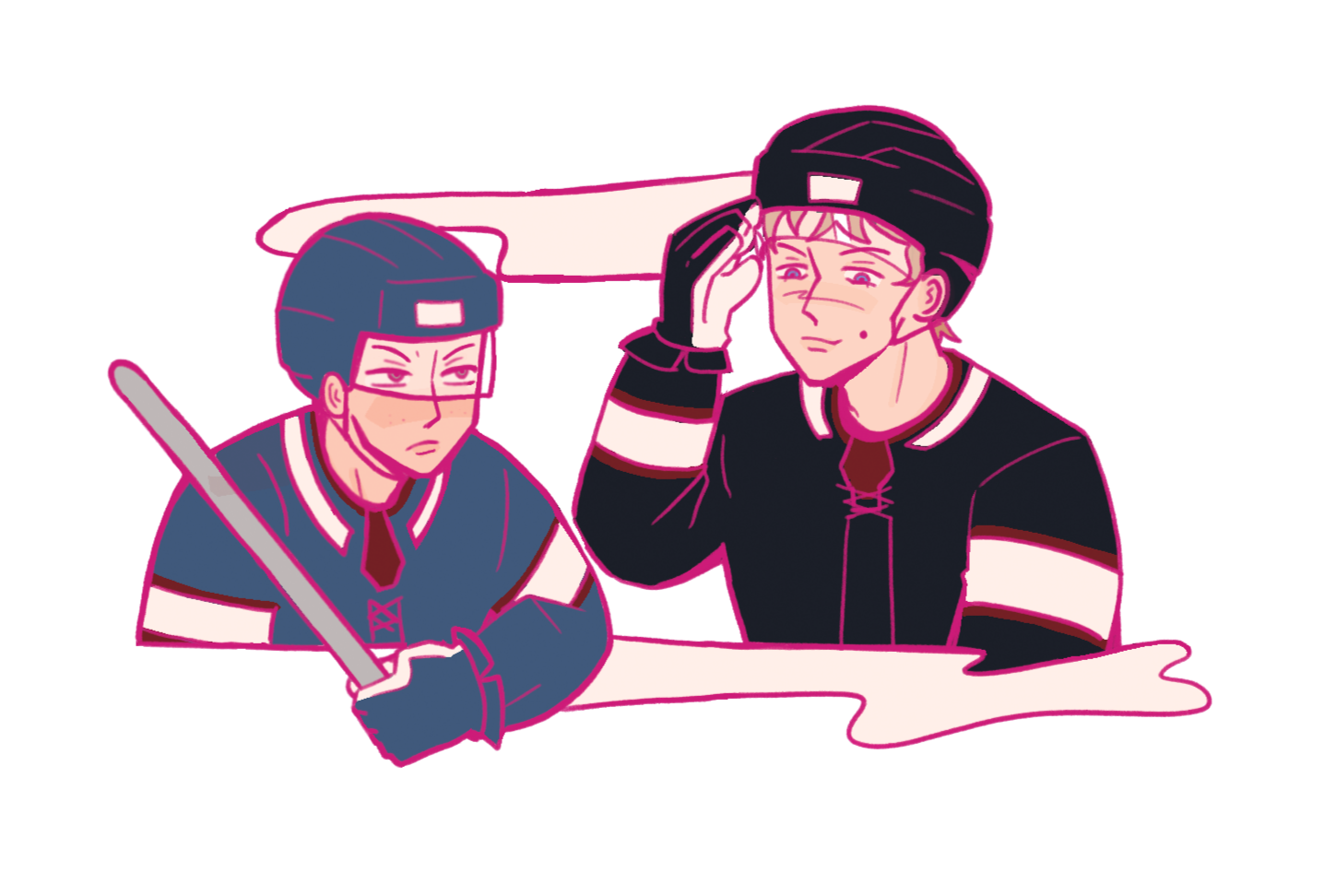
“Will you come to my cottage?” For fans of the hit series Heated Rivalry, this question became a playful way to identify fellow watchers and allude to one of the show’s most anticipated episodes. But beyond the memes and inside jokes, the series has taken on greater significance for viewers who see aspects of their identities reflected in the story.
Based on the Game Changers book series by author Rachel Reid and adapted by director Jacob Tierney, Heated Rivalry is a six-episode sports romance taking Hollywood by storm. The show follows the closeted relationship between star hockey players Shane Hollander (played by Hudson Williams) and Ilya Rozanov (played by Connor Storrie).
While the show gained rapid popularity for its sexually explicit content, conventionally attractive cast and occasional hockey matchups, Heated Rivalry is also an exploration of acceptance and self-identity. Beneath its steamy sex scenes, Heated Rivalry is fundamentally about navigating a queer identity in an aggressively heterosexual, hypermasculine space. Shane’s journey is further complicated by his experience as a biracial Asian Canadian man in a historically white sport.
In recent online discourse, audience members have expressed mixed feelings about how Heated Rivalry handles racial identity. Besides its centering of an Asian main character, the show only explicitly acknowledges Shane’s identity a handful of times. To some, this subtle portrayal is sufficiently effective.
Weinberg second-year Timothy Chiu says Shane is a well-thought-out representation of the Asian queer identity. While his queerness and Asian heritage are central to who he is, Chiu says that the character doesn’t proclaim these aspects of himself — nor is he ever reduced to those labels.
“Being a fellow queer Asian, it’s just so cool to be able to resonate with [Shane] and see so many people rally behind his experiences, whether or not they have that lived experience,” Chiu says.
Chiu adds that the character reflects how many Asians grapple with the external and internal pressures of being members of a minority. He works hard to preserve his public image, as shown through his concern with keeping the relationship a secret.
Chiu says Heated Rivalry’s popularityindicates a cultural shift in how mainstream media is highlighting LGBTQ+ stories featuring minoritized groups.
Weinberg second-year Devi Karunakar also appreciates the show’s subtle representation of ethnicity. As a person of multiracial heritage, Karunakar says she enjoyed how Shane’s racial background didn’t noticeably impact the storyline.
“[Shane’s race] is important to him and him as a person, but I don’t think it’s that important to the story,” Karunakar says. “I don’t think it really changes that much to their relationship. Like, he’s still just a person.”
In many ways, Shane’s depth as an Asian individual hinges heavily on Williams’s own interpretation of the character and his ethnic identity.
Williams and his character have certainly taken the internet by storm, in no small part thanks to his charm, good looks and Cinderella-story rise to fame. The character and actor have raised questions about the role of mainstream media representation and inclusivity. Some netizens have questioned if white creatives like Reid and Tierney can responsibly champion queer characters of color.
Williams, who is of Korean descent, plays Shane, a character of Japanese descent. Similarly, Taiwanese and Filipino American actress Christina Chang plays Shane’s mother. These casting choices sparked debate regarding the “interchangeability” of Asian ethnicities in film and television.
Despite these critiques, director Jacob Tierney has made it clear that he was committed to a meaningful representation of Shane’s ethnic identity. In a Q&A following the show’s Toronto premiere, Tierney said casting Williams was a highly intentional and necessary production choice to honor the authenticity of Shane’s biracial background in the books.
“It was important to me because there are not a lot of people who are not white in the NHL, and there are not a lot of people who are not white as leads in romances either,” Tierney said. “I think a lot about Shane’s personality is as an outsider, and to me, Shane had to be Asian.”
While fans have praised Tierney for his intentions, viewers will have to wait for a more in-depth exploration of race in the show. Given the show’s high percentage of sexual content, the ways in which stereotypes about Asian masculinity and sexual desire arise must be explored.
Throughout history, Asian men have often been stereotyped as effeminate, asexual and passive in their desires. Heated Rivalry arguably defies these stereotypes, instead characterizing Shane as a conventionally attractive, powerhouse athlete with high sex appeal. Still, some social media users have criticized this choice as reinforcing stereotypical Asian submissiveness.
However, Weinberg fourth-year Austin Moy sees Shane’s vulnerability in the bedroom as consistent with the rest of Shane’s personality. Those who interpret Shane’s position in the sexual relationship as stereotypically problematic are imposing their own heteronormative expectations onto the character, he says.
Moy says to continue portraying Shane’s sexuality in an authentic and thoughtful way, the show must “explore the reasons why” he fulfills the role that he does — namely that Shane’s willingness to relinquish sexual dominance in their private relationship is in direct contrast to his obsession with public perception. Shane’s desire to control as many aspects of his life as possible is overridden when he is with Ilya.
While there is still much to be explored in Shane and Ilya’s sexual relationship, Asian American Studies program assistant Jasmine Zou says she wishes the show actually featured more hockey. Doing so would allow viewers to see how Shane actively resists or reacts to the implicit hostility of his environment.
“By leaving some of the uglier sides of the hockey culture out, it makes it more difficult to explain [how Shane’s identities have marginalized him],” Zou says. “Like why can’t they come out right now? [The story] is not showing me the ugliness of the sport, which may be well known in real life, but I don’t think was super established in the universe. And the same thing goes with the racism that Shane alluded to, that he faced growing up.”
Associate professor of Asian American Studies Raymond San Diego’s primary critique of the show is its source material: Reid’s Game Changers.
“It was very obvious to me that this was written by a straight woman,” San Diego says. “There are aspects of his masculinity [that] intersects with his race as well as his sexuality … [and] lend itself more to a particular fantasy.”
Specifically, San Diego says Shane’s brief relationship with the character Rose Landry depicts Shane as “straight-passing,” while a queer male Asian writer might have Shane be clearly gay.
However, the limitations of Reid’s perspective as a non-Asian writer do not completely erase the representation that Shane’s character provides. Karunakar says Shane’s visibility as an Asian athlete in an overwhelmingly white sport is key to the impact that Shane’s character can have, both on young athletes in the show and in real life.
Weinberg second-year Macy Rhie shares a similar perspective, adding that Shane’s on-screen moments with his mother helped flesh out the representation of his character.
“I think it was crucial that there were quite a few scenes with his mom — who he gets his Asian heritage from — as it showed how Shane interacts with his Asian identity,” Rhie says. “The show engaged with race well, especially in scenes where Shane’s mom would remind him that he was the ‘example’ for young Asian kids who wanted to be hockey players.”
Rhie says she is interested in seeing Shane’s mom have a larger presence in the rest of the series to add more depth to his cultural background.
With season two set to begin filming later this year, viewers are naturally hopeful that Tierney will build upon the emotional complexities of Shane and Ilya’s relationship, including their individual hardships. Doing so could also open the door for a deeper, more intentional consideration of Shane’s identities. While many viewers are eagerly awaiting the next installment, season two isn’t projected to be released until the spring of 2027. So until then, there’s only one question left to ask: Will you come to my cottage this summer?