
Matcha men
For Asian men, being “performative” is a role they were born into.
by Sophia Memon


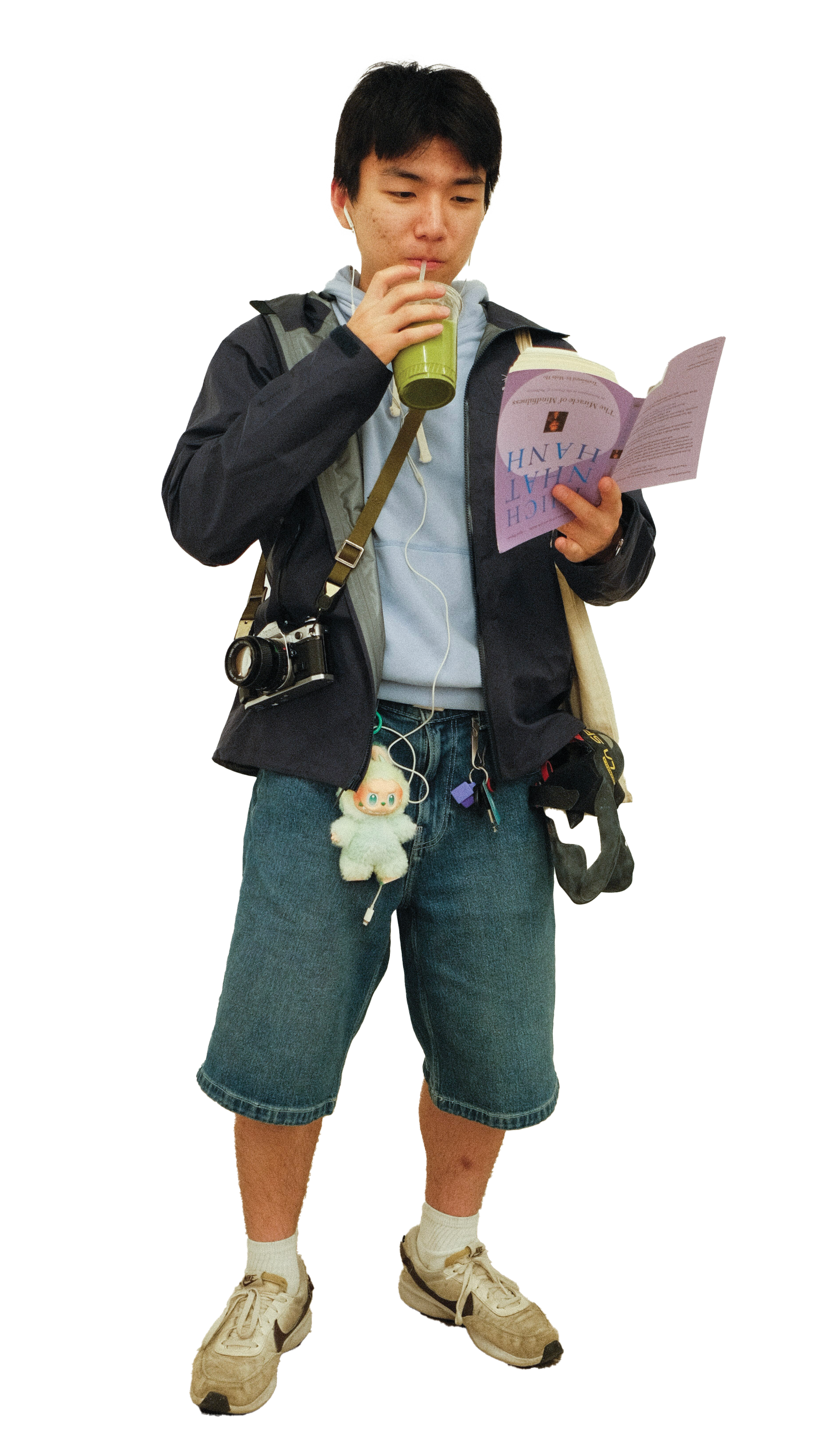
With three carabiners fastened to his jorts and an orange and blue checkered flannel draped over his shoulders, Weinberg second-year Daniel Murdoch sits across from me. He’s holding a tote bag covered in colorful pins, flipping through an upside-down signed copy of Just Kids by Patti Smith. He describes the book as one of the most performative pieces he owns today.
Murdoch, like many of us, is familiar with the ‘performative male’ trend overtaking social media — he even spent this past summer in a performative male book club. But Murdoch isn’t a performative male; he says he’s simply an East Asian guy playing into the character.
The term ‘performative male’ is spreading like wildfire; it refers to men with traits and aesthetics associated with sensitivity and softer masculinity, which, Murdoch says, has often been attributed to Western conceptions of what Asian masculinity looks like. With the rise of men drinking iced matcha and reading The Feminine Mystique near cafe windows, performative male contests have spawned across dozens of U.S. cities and TikTok For You pages. The trend pokes fun at those who drink matcha, read feminine literature and wear flannels and jorts — presumably not out of real interest, but as a calculated attempt to appeal to the feminine gaze.
“Being a performative male as a bit is funny,” Murdoch says. “But I wouldn’t want to be seen as someone that I’m actually not.”
Communication second-year Patricia Liu was a semi-finalist at the University of California, Berkeley’s performative male contest in August, placing in the top 10 with her drawn-on beard, wireless earbuds and matcha. She says she’s enjoying the joke while noticing that a lot of the people portraying the performative male archetype are just Asian men playing into the overrepresentation of their fashion and matcha.
Michelle Huang, assistant professor of English and Asian American Studies, describes how the performative male trend relates to the long history of Asian Americans having to assimilate to whiteness in order to be treated with respect.
“I think it’s sort of shocking to people from my generation or older,” Huang says. “It’s interesting that Asian American stuff and culture has become mainstreamed.”
Self-described matcha lover Matthew Lee, a Weinberg second-year, says he’s become more hesitant to drink matcha in public as a result of the trend. He says the trend isn’t inherently harmful, but can deter people from engaging with their interests, some of which were culturally relevant among Asians before becoming trends.
“This kind of trend has happened before,” Lee says. “With taro, years back, I think that became a widespread trend. And now I also think that hojicha is spreading very quickly in these trendy cafes and everything. So my question is what happens next.”