
Evolving enclave
Residents, students and business-owners work to revitalize the Argyle neighborhood.
STORY BY MERYL LI
DESIGN BY GRACE SUN
PHOTOS BY JASMINE YI


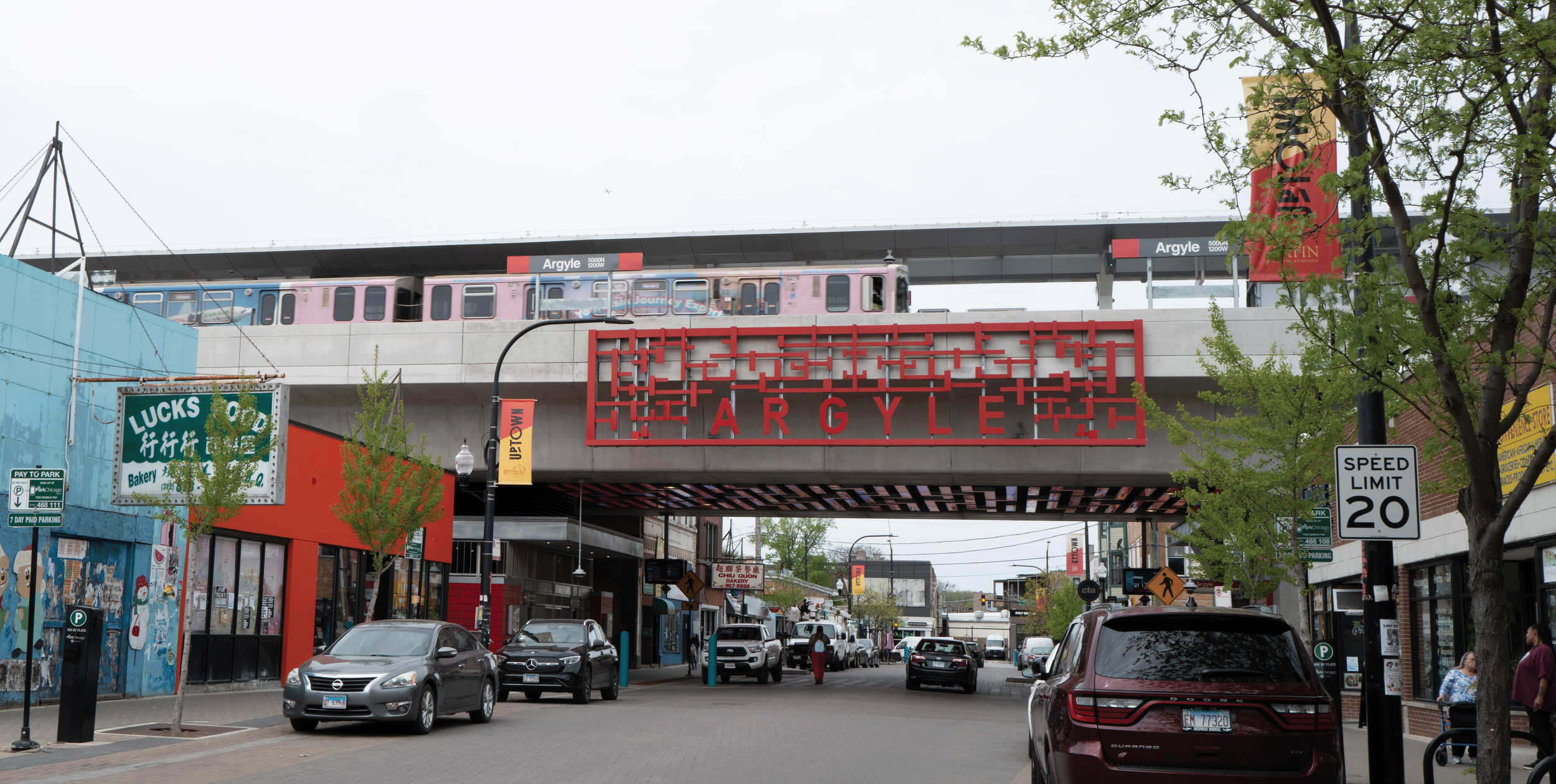
Growing up in the Sauganash neighborhood on the Northwest Side of Chicago, McCormick third-year Viet Tong says he cherished going to Argyle at least once or twice a week, where his family bought groceries from the Asian supermarket Tai Nam Food Market. He says he remembers seeing the store’s parking lot full, with people who looked like him supporting local businesses.
“Thinking of it now, it’s comforting, heartwarming and familiar,” Tong says. “It was something that showed me I had a different kind of community.”
Tong was not just a visitor in the area. His family has opened three businesses in the community since 2009, although two were unsuccessful. Tong’s family now runs Spa Nail Supply Chicago near Argyle Street, a retail store specializing in tools and equipment for nail technicians and salons.
The store joins a long history of Vietnamese, Chinese and other Asian businesses around Argyle, which has served as a hub for Chicago’s Asian American community since the 1970s.
However, Argyle business owner and community organizer Jennifer Pham says that the neighborhood has changed in recent years.
Jennifer Pham says she noticed people were purchasing and eating less from shops on Argyle at the height of the COVID-19 pandemic. She felt like the anti-Asian sentiment at the time made people scared to buy from Asian-owned businesses.
Renovations to the Argyle CTA Red Line stop also contributed to a decline in foot traffic, she says. At the same time, affordable housing options in the area have been significantly reduced, with at least five buildings for low-income renters closing down over the last decade.
In response to these changes, longtime residents and business owners have launched initiatives and hosted community events to draw visitors back to Argyle and preserve the area’s Asian culture. For some NU students, Argyle is a source of comfort and a place to connect with their heritage.
Forcing residents out

Weinberg fourth-year Brian Dinh says Vietnamese culture was more accessible back home in the Bay Area, and found it harder to engage with his heritage at NU. His desire to find that connection again led him to Argyle, which he now thinks of as a “second home.”
“It helped me reorient myself within a new environment,” Dinh says. “As a Vietnamese person, it’s still reassuring to see that there are other Vietnamese in the diaspora in the Midwest.”
However, based on his own observations and anecdotes from local residents, Dinh says there has been an increase in luxury apartments and rising rent costs in the area.
“It’s a call to action for me to find my roots.”
— Viet Tong, McCormick third-year
Two single-renter-occupancy (SRO) buildings in Uptown have closed since December. These buildings housed low-income renters in dormitory-style rooms. Most recently, the SRO Chatelaine closed in February, forcing its residents to move out.
Dinh says he has chosen to center his senior thesis around the impact of gentrification in Argyle because he appreciates the neighborhood and wants to see “what can be done about it, if anything.”
From his research, Dinh says supporting local businesses while recognizing that their success can attract outside interest is a “difficult balance.” Such attention can fuel gentrification as real estate firms commodify Argyle.
The rising rent prices have affected the neighborhood’s cultural foundation, too. Argyle has lost a lot of its Vietnamese community in the last decade, Tong says.
“Vietnamese culture is losing its presence in Chicago,” Tong says.
Community members have noticed similar changes in the neighborhood. Joey Pham serves as the public representative and family archivist for the Vietnamese sandwich shop Ba Le Sandwiches, which has a flagship store at the head of Argyle Street.
When she first moved to the community in 2005, Joey Pham says Argyle was a “different landscape,” with a larger Vietnamese population and less gentrification.
Joey Pham’s grandfather, Le Vo, started the Ba Le Sandwiches business in California in the 1980s after immigrating from Vietnam. In 1988, their family expanded to Chicago, where Joey Pham has worked since she was 16.
“My family is incredibly fortunate to start this chain of really wonderful restaurants that remind people of home,” Joey Pham says. “At the same time, the country itself pushes us out because of racism or predatory developers who just want to make money.”
Bringing the neighborhood “back to life”
When she came back to Argyle over a decade ago to run her family’s pharmacy, Jennifer Pham says she noticed that foot traffic had declined and that neighborhood businesses had closed their doors.
Jennifer Pham grew up on Argyle in the ‘90s. Her parents, two refugees from Vietnam, started the first Vietnamese business on Argyle Street: the now-closed Saigon Pharmacy. She says she remembers walking around with her dad as he checked in on their neighbors and shared tea and meals with his friends.
“Everyone knew everyone,” Jennifer Pham says. “It was very normal for me to see grandmas outside cooking, grilling, kids playing Chinese jump rope in the corner and loud music playing.”
To revive the neighborhood, Jennifer Pham co-founded the nonprofit organization HAIBAYÔ in 2019 with her friend Hac Tran. Tran and Jennifer Pham work together to support local businesses and preserve Argyle’s culture through neighborhood events, mutual aid efforts and small business owner spotlights on social media.
HAIBAYÔ also opened a cafe inside their building on Argyle Street where they serve Asian coffees, teas and snacks. Having the space allows them to host regular neighborhood events. The building also features a mini museum displaying archival materials outlining the history of the area.
“It’s a missing home that I feel as I’m building this out, like I’m trying to bring back what my parents and I felt,” Jennifer Pham said. “I felt a need to continue what they created.”
Dinh says he has attended a few events on Argyle, like HAIBAYÔ’s Vietnamese-language coffee chats, mutual aid fundraising variety shows and comedy showcases. He says he’s cautiously optimistic about their cultural preservation efforts for a new generation.
“I think HAIBAYÔ’s revitalization work is well-intentioned and needs more time,” Dinh says. “I am hopeful that it can avoid pitfalls that commodify the neighborhood instead of protecting it.”
Since she started this work, Jennifer Pham says she has noticed more young people engaging with the community than a decade ago. She says she doesn’t know if it’s directly linked to their efforts, but she has noticed an uptick in foot traffic. She says “there’s been a lot of love being poured into this area.”
Down the road from HAIBAYÔ, First Sip Cafe owner Genie Cong has also noticed the neighborhood gaining traction. In addition to serving traditional drinks and desserts, the cafe hosts community events like stand-up comedy and pop-up markets.
Cong took over the business from her two sisters-in-law in February, and she has lived in the neighborhood since 2006. She says she has noticed the neighborhood change, with more businesses and people moving into the community.
“I just feel so proud to be one of the business owners in Argyle,” Cong says.
Reconnecting with the community
As Argyle evolves, NU students with connections to the area continue finding ways to stay involved with their cultural communities, both on campus and beyond.
Tong says the “decaying presence” of culture on Argyle has made him want to look for his culture more. He says he has started to feel like he’s losing touch with his Vietnamese community, especially after his extended family moved out of Illinois.
“It’s a call to action for me to find my roots,” says Tong, who is a member of NU’s Vietnamese Student Association and attends a Vietnamese church. “The best idea I have to connect with my culture is to be friends with Viet people.”
Tong adds that he visits Vietnam for volunteer work and family vacations. He last visited in 2024 and plans to go again this summer, he says.
Dinh recently started volunteering for a grocery distribution program in the Argyle area, which is organized by the Vietnamese Association of Illinois, a nonprofit that offers support services and celebrates Vietnamese culture in Illinois.
The program aims to help elders in the community. Volunteers give out groceries and keep residents up-to-date on recent events in the area.
“I still feel like the community is there. There’s people I say hi to in the neighborhood and meet during mutual aid and grocery distribution,” Dinh says. “Argyle still has its own character.”
Dinh says he feels sad when he notices new luxury apartment complexes while walking through Argyle, or when he hears about affordable housing buildings closing down. Nevertheless, Dinh says he is hopeful for Argyle’s future because he knows that local organizations are working to revitalizing the community.
“Since there are people still there, that means there’s people still worth fighting for,” Dinh says.

Edward Simon Cruz contributed to reporting.